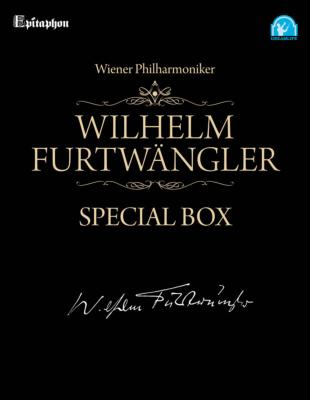
New discovery! The ninth the Beethoven symphony which is different for one day, Furtwangler,and Vienna philharmonic orchestra's world's first release!
Beethoven Symphony No.9 D minor Op.125
Wilhelm Furtwangler Conducts
Irmgard Seefried [Sopran]
Rosette Anday [Alt]
Anton Dermota [Tenor]
Paul Schoffler [Bass]
1953 May 30 Wien, Musikverein
MONO HQCD
Bonus of the first time press
The replica of the NICOLAI KONZERT program of February 3, 1952
"The ninth symphony" of Furtwangler and Beethoven by the Vienna philharmonic orchestra played this time on May 30, 1953 by the new discovery will be released. Because Otto Nicolai concert of January 23, the same year was canceled as for this on the way, it is the recording of the live broadcast when it postpones it, and it was performed as a concert.
There are an LP and a CD of the existing release in recording of May 31, the same year, and it is well known, but this performance is different from the thing of 31st in a considerable part. I stand to the splendor of the molding that these play a personality and score shown in the great master most later years precisely, and is cooked up same base, but a little over 1 level sense of unity of the live broadcasting characteristic waits, and there makes a great difference by this performance to swell with feeling of strain.
About the sound quality, a tape hiss and a waw flutter in 4th Mov. are seen a little, but it may be said that, as a whole, sound balance is well excellence. In addition, it is neighboring sound collecting for an orchestra and a chorus, a soloist in the whole beginning in timpani, cymbals by some differences of the microphone setting in comparison with the recording of 31st.
About the performance, as for the expression that burnt exhaustively only by the live broadcasting, the admirability cannot at all help through a sense of unity, all songs to swell by overwhelming expression, fierce how to beat great master inimitableness of the timpani in the recapitulation beginning, the arising of power competing for for strong pressure with the second movement of the first subject and peremptory driving force, expression of the most beauty by a fast flow with the third movement, a rather late tempo in 4th Mov. with the first movement. The orchestra is good, too.
I am first about the tempo and quicken it with two or three movements (even if the third movement in particular includes all other recording, fastest) and adopt a rather rather late tempo in 4th Mov. However, the twinship to the wartime performance is felt of postwar recording fastest altogether, too.
A way of devotion to the music is deep, and I am different from the other performances in both gangs 2 and the taste, and the characteristic of this performance has a big impression for After having listened with the thing which showed the arising that grew tense by little expression of the disorder till the last from the beginning generally while having the taste of the great master most later years. It seems that the CD to appear this time is really precious.