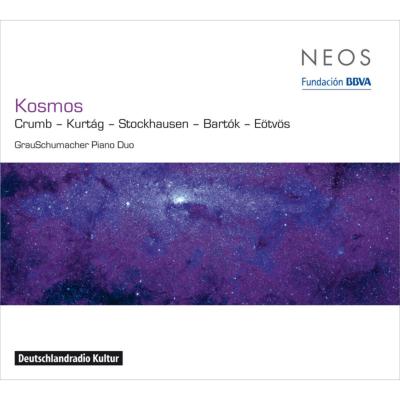
SACD Import

Kosmos -Crumb, Kurtag, Stockhausen, Bartok, Eotvos : Grau Schumacher Piano Duo

Item Details

Genre
:
Catalogue Number
:
NEOS20802
Number of Discs
:
1
Label
:
Format
:
SACD
Other
:
Hybrid Disc,Import

Product Description

Kosmos - GrauSchumacher Piano Duo

Crumb: Celestial Mechanics (Makrokosmos IV)
Kurtag: Jatekok
Stockhausen: Tierkreis - 12 Melodien der Sternzeichen
Bartok: Seven Pieces for Two Pianos
Eotvos: Kosmos

GrauSchumacher Piano Duo

Digital Recording: 2007
SACD Hybrid
CD STEREO/ SACD STEREO

Cosmos

It used to be primarily cherubim and seraphim that were responsible for the music of the spheres. Heavenly hosts provided the accompaniment to eternal bliss or played dance tunes for Saint Ursula and the 11,000 Virgins. Later the angels had to compete for heaven with astronauts. But even long after “Heaven” had mutated into the “Cosmos”, and the metaphysics of “stars” had given way to the astrophysics of “celestial bodies”, “Heaven” now demystified by science, still remained a domain for the transcendent and ineffable, a realm of utopias …

Not least of all for 20th-century composers. Arnold Schoenberg ventured into the uncharted territories of atonality with his Second String Quartet, which set Stefan George’s almost portentous words “I feel the air of another planet”. In Die Harmonie der Welt (The Harmony of the World) Paul Hindemith, now turned conservative, saw the “harmony of the spheres” solely in the music of the planets, a counterweight to the slaughter of the Thirty Years’ War.

George Crumb, in Celestial Mechanics, retraced the movements of celestial orbs as “cosmic choreography”; John Cage, in Atlas Eclipticalis, proclaimed a map of the heavens to be a musical score and its plotted stars to be notes; and Gerard Grisey used radio waves from pulsars for his Le Noir de l’Etoile. Olivier Messiaen, a devout Catholic, continued to view the stars as divine points of light, aiding human beings in their ascent from the canyons of darkness. Finally there was Karlheinz Stockhausen, second to none among modern composers in viewing his music as the direct embodiment of cosmic sounds. And weren’t Ligeti’s Lux aeterna and Johann Strauss’ waltzes transformed into celestial music by cinematic images, burned into our collective cultural memory and danced to by spaceships and stars, now liberated from the laws of physics and beholden to the laws of music?

The GrauSchumacher Piano Duo likewise set out for the stars in “Kosmos”, and several of the aforementioned composers form part of their journey through macro- and microcosms along the edges of musical constellations. The destination and centre of their journey - and also the title of this CD - is Kosmos, a work for two pianos which the Hungarian composer Peter Eotvos composed at the age of 17 as a spontaneous response to Yuri Gagarin, who became the first man to fly into space in 1961. Kosmos is nothing less than a pocket history of the universe lasting roughly twelve minutes. “After the Big Bang”, Eotvos explains, “the galaxies, suns and stars slowly came into being. Cosmic shapes become increasingly complex, and space will eventually reach its maximum point of extension. After that the universe will begin to shrink, and the shapes will dissolve in preparation for the next Big Bang.” A cycle of emergence and disappearance on a galactic scale!

This central work is surrounded, in a manner of speaking, by four concentric rings. Proceeding from the inside, we encounter
a) three and four pieces, respectively, from Bela Bartok’s Seven Pieces from Mikrokosmos,
b) two melodies each from Karlheinz Stockhausen’s Tierkreis (Zodiac) cycle,
c) two brief and quiet pieces each from Gyorgy Kurtag’s cycle Jatekok (Games) and
d) two movements each from George Crumb’s Celestial Mechanics, the fourth and final part of his Makrokosmos cycle.

We approach Kosmos in what might be called an elliptical orbit through this system of concentric rings. We begin at the stars Alpha Centauri and Beta Cygni in Makrokosmos, brush Kurtag’s “Infinity” and pass through the constellations of Capricorn and Aries and the Mikrokosmos to reach Peter Eotvos’ Transylvanian galactic Kosmos, at once the destination and the turning point of our journey. We then return by a different orbit through Mikrokosmos, the constellations Cancer and Libra and the “Infinity” to reach the stars Gamma Draconis and Delta Orionis in Makrokosmos.
Interstellar navigation is, of course, a complex affair. Motions can overlap, and we encounter centrifugal and centripetal forces without which travellers will vanish into the void of the universe. The same applies to our musical journey. It, too, has overlaps; and it, too, must strike a constant balance between mutually repellent forces.

“Kosmos” follows a programme which the GrauSchumacher Piano Duo have set down to the nethermost detail. For one thing the pieces have structural points in common: Kurtag’s descending strings of pitches not only find a response in the ascending chord progressions of Bartok’s Akkord- und Trillerstudie (Chord and Trill Study), they also dominate Peter Eotvos’ Kosmos. Other connecting links include arpeggios and trills, which impart cohesion to the mutually repellent elements.

But most of all this CD is permeated by a quite special atmosphere, which goes beyond the pieces’ titles and motivic relations to project an intrinsic rapport among such antithetical figures as Kurtag and Stockhausen, Crumb and Bartok. This atmosphere is one of breadth and infinity, of silence and timelessness, but also of loneliness and abandonment. Sometimes there is even a yearning sense of homesickness, as in the tonal melody of Bartok’s Ungarisches Volkslied (Hungarian Folk-Song) or the quotation from Klange der Nacht (The Night’s Music) in Eotvos’ Kosmos.

Finally, the idea of infinity pervades the entire programme like a connecting thread. It can be found in Bartok’s Perpetuum mobile and Ostinato as well as in Gyorgy Kurtag, who devoted an entire section of Jatekok to Spiel mit dem Unendlichen (Game of the Infinite). Peter Eotvos even confided that he was ‘almost intoxicated by the sense of infinity’.

As “Kosmos” is a journey through space, it is only natural that acoustical space played a role in this co-production with Deutschlandradio Kultur. The microphones were spatially positioned to create a sense of breadth; the stereophonic duality of the two pianos dissolves into three-dimensional space through the recording’s surround-sound; and the two pianos, rather than being static, become themselves something akin to celestial orbs full of ethereal music.

But as in every good science fiction movie, here too the journey into the endless expanses of the universe, the journey through the cosmos, ultimately becomes a journey into the interior of the human spirit. Whether in Stanislaw Lem’s Solaris or Stanley Kubrick’s 2001: A Space Odyssey, at the end of the journey the travellers through space and time ultimately encounter - themselves. “Kosmos” is thus not only one of the GrauSchumacher Piano Duo’s most beautiful, but one of the most personal programmes.

Rainer Pollmann, Translation from the German: J. Bradford Robinson ( NEOS Music )

Track List   

  • 01. I. Alpha Centauri
  • 02. II. Beta Cygni
  • 03. Blumen Die Menschen
  • 04. Spiel Mit Dem Unendlichen
  • 05. ... Blumen... Auch Die Sterne
  • 06. Steibock-Capricorn
  • 07. Widder-Aries
  • 08. 1. Bulgarischer Rhythmus
  • 09. 2. Akkord - Und Trillerstudie
  • 10. Perpetuum Mobile
  • 11. Kosmos Version for Two Pianos
  • 12. 4. Kurzer Kanon Und Seine Umkehrung
  • 13. 5. Neues Ungarisches Volkslied
  • 14. 6. Chromatische Invention
  • 15. 7. Ostinato
  • 16. Waage - Libra (Venus)
  • 17. Krebs-Cancer
  • 18. Blumen Die Menschen
  • 19. Sternmusik
  • 20. Hommage a Sproni
  • 21. III. Gamma Draconis
  • 22. Delta Orionis

Customer Reviews

Comprehensive Evaluation

☆
☆
☆
☆
☆

0.0

★
★
★
★
★
 
0
★
★
★
★
☆
 
0
★
★
★
☆
☆
 
0
★
★
☆
☆
☆
 
0
★
☆
☆
☆
☆
 
0

Recommend Items