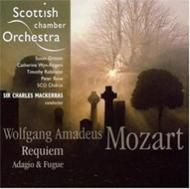
Wolfgang Amadeus Mozart:
Requiem in D minor, K626 ed. R. Levin
Adagio & Fugue in C minor, K546
Susan Gritton, soprano
Catherine Wyn-Rogers, contralto
Timothy Robinson, tenor
Peter Rose, bass
Scottish Chamber Orchestra and Chorus / Sir Charles Mackerras, conductor
Recorded at Caird Hall, Dundee, UK 14-16 December 2002
Mozart's Requiem - the composer's last and unfinished work - was commissioned by Count Franz von Wallsegg, who wished to have it performed in memory of his departed wife as his own composition. In order not to forfeit the handsome commission fee, Mozart's widow Constanze decided to have the work completed in secrecy, so that the finished version could be presented as her husband's final effort. The Requiem is known to the general public in the version undertaken by Mozart's pupil Franz Xaver Sussmayr. Sussmayr based his completion on Mozart's virtually complete score of the INTROITUS and drafts of all sections from the Kyrie fugue to the Hostias. These contain the completed vocal parts (solo and chorus) and the orchestral bass line, with occasional motives for the orchestral accompaniment. However, the Lacrimosa breaks off after the eighth bar. To these Mozartean materials Sussmayr added settings of the SANCTUS/Hosanna, Benedictus, AGNUS DEI and COMMUNION (Lux aeterna - Cum sanctis tuis). (The COMMUNION is merely a newly texted version of part of the INTROITUS and of the Kyrie fugue.)
In making his completion Sussmayr could draw on the partial completion of the SEQUENCE done by Joseph Eybler soon after Mozart's death. He may have had access to a further important source - a sketch leaf which includes contrapuntal studies for the Rex tremendae as well as the beginning of an Amen fugue to close the Lacrimosa. However, Sussmayr did not include a realization of this fugue in his version; he set the Amen with two chords at the end of the Lacrimosa.
The key question about Sussmayr's version is whether any of the portions of the Requiem that are not in Mozart's hand were based on his ideas. Although Sussmayr claimed to have composed these alone, they display the tight motivic construction of Mozart's fragment, in which a small number of themes recurs from movement to movement. (Sussmayr's own music lacks such motivic interrelationships.) Perhaps, then, the "few scraps of music" Constanze Mozart remembers giving to Sussmayr together with Mozart's manuscript contained material not found in Mozart's draft. Mozart also may have suggested certain ideas to Sussmayr on the piano.
A clear evaluation of the movements Sussmayr claimed to have composed is clouded by unmistakable discrepancies within them between idiomatically Mozartean lines and grammatical and structural flaws that are utterly foreign to Mozart's idiom. First attacked in 1825, these include glaring errors of voice leading in the orchestral accompaniment of the SANCTUS and the awkward, truncated Hosanna fugue. Furthermore, Sussmayr brings back this fugue after the Benedictus in B-flat major rather than the original D major - in conflict with all church music of the time.
The version heard in this evening’s performance seeks to address the problems of instrumentation, grammar and structure within Sussmayr's version while respecting the 200-year-old history of the Requiem. A clearly drawn line of separation, in which everything except the contents of Mozart's autograph was to be considered spurious per se, was explicitly rejected. Rather, the goal was to revise not as much, but as little as possible, attempting in the revisions to observe the character, texture, voice leading, continuity and structure of Mozart's music. The traditional version has been retained insofar as it agrees with idiomatic Mozartean practice. The more transparent instrumentation of the new completion was inspired by Mozart's other church music. The Lacrimosa has been slightly altered and now leads into a non-modulating Amen fugue. (Other completions of the fugue modulate extensively.) The second half of the SANCTUS resolves the curious tonal discrepancies of Sussmayr's version, and the revised Hosanna fugue, modeled after that of Mozart's C-minor Mass K.427/417a, displays the proportions of a Mozartean church fugue. The second half of the Benedictus has been slightly revised and is connected by a new transition to a shortened reprise of the Hosanna fugue in the original key of D major. The structure of the AGNUS DEI has been retained, but the infelicities of Sussmayr's version have been averted in the second and third strophes. In the final Cum sanctis tuis fugue, the text setting has been altered to correspond to the norms of the era.
It is hoped that the new version honors Mozart's spirit while allowing the listener to experience Mozart's magnificent Requiem torso within the sonic framework of its historical tradition.
Robert D. Levin: 1995 ( Linn Records )