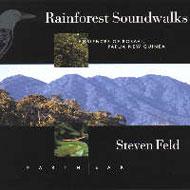
If you travel all the way into Papua New Guinea's interior from any direction you'll ultimately come to the country's Southern Highlands Province. Travel inward further still, and you'll reach Mt. Bosavi, an extinct volcano rising to eight thousand feet. In the northern foothills that ramble six thousand feet below lies a vast mid-montane rainforest. Bosavi is the name it's two thousand residents give to the land and to themselves. Since 1976 I've been a regular visitor here, learning how Bosavi people create a sense of place in the rainforest ecology. I've studied how birds are named and known by their sounds, and how their voices connect the forest world to the spirit world through myths and rituals. I've been taught how poetry creates maps of forest trails, and why these song paths hold memories of people and land. I've realized that sound deeply shapes the Bosavi world, and that listening is a vital way of participating in it. I've given my ears to this sonic way of knowing, this Bosavi acoustemology, and on Rainforest Soundwalks you'll hear a touch of what I've encountered and tried to absorb. Think of it as a sonic suggestion of what it might be like to live in a different auditory body and another sound world. So how did I get here? After making documentary LPs in the 1970s, I came upon The Tuning of the World and the World Soundscape Project of R. Murray Schafer. His insistence that research on acoustic ecology be disseminated as musical composition led me to experiment with soundscape radio in the 1980s. And that led to Voices of the Rainforest, my 1991 CD for Mickey Hart's series The World -- a sound portrait of the rainforest environment and of the vocal, poetic, and musical forms it inspired for Bosavi people. Many naturalists and sound artists responded by requesting a recording devoted completely to Bosavi's forest ambiences. Ten years later, here it is. ***** 1. seyak, butcherbird Seyak is the Bosavi name of the Hooded butcherbird, Cracticus cassicus. A conspicuous local presence, seyak typically fly from tree to tree in the open, then perch, pause, and let out one of their flamboyant calls from an exposed branch at the forest edge. The Birds of New Guinea handbook describes the call this way: 'A loud, jumbled bugling and yodeling, which combines bell-like notes and liquid rollicking phrases with hoarse notes, gurgles, musical croaks, and duets' (Bruce M. Beehler, Thane K. Pratt, and Dale Zimmerman; Princeton University Press, 1986). Like all Bosavi birds, seyak are locally heard as one of the many everyday clocks and tuning forks of the natural world. But Bosavi people hear much more than that. They hear these voices as 'gone reflections,' the reverberant spirits of their dead who have passed on to the treetops. Deina Hewabe and I recorded this seyak one December morning from a ridge above a forest creek. Emerging from the white noise of predawn rains, mists and waterway sounds, seyak wakes the surrounding forest. As fog lifts, voices of brown orioles, friarbirds and other butcherbirds mimic and reply, while frogs croak at the creekside below. As if gradually taking note of his accompanists, seyak progressively slows the pace of his call from sixteen to six phrases per minute, allowing the more distant voices an increasing presence. While quite familiar with the daily variety of butcherbird calls, I had never heard anything as long and as musically varied as these two hundred consecutive phrases. Deina was equally moved; 'really different!' was his emphatic remark as seyak finished. A few weeks after making this recording I had an impromptu visit from Seyaka Yubi, one of my oldest Bosavi friends. Seyaka's father, Yubi, who died in 1984, was my first forest guide. His extraordinary knowledge of Bosavi birds is discussed in my book Sound and Sentiment. In fact, I titled the book's bird chapter with one of Yubi's pointed comments about our different realities. What he said was: 'to you they are birds, to me they are voices in the forest.' Yubi's words were once again brought home to me when I played this sey
 プラチナ会員
 ゴールド会員
 ブロンズ会員
 レギュラー会員