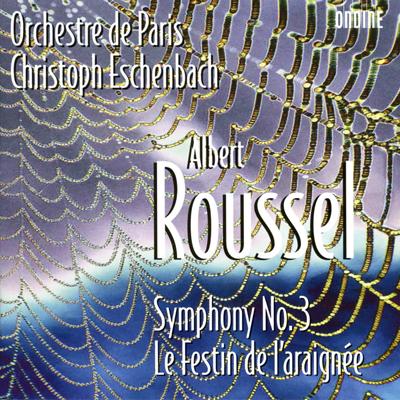
This Albert Roussel disc couples the Third Symphony with one of the composer's most popular pieces, the complete music for the one-act pantomime ballet Le Festin de l'araignée. This recording completes a cycle of three releases featuring the four symphonies and two ballets by the French composer, performed by the Orchestre de Paris under music director Christoph Eschenbach.
The Third Symphony, which was given its world première in Boston in 1930, is a true masterpiece and remains the most popular of Roussel's symphonic works. Le Festin de l'araignée (The Spider's Feast) was written to a libretto by Gilbert de Voisins and completed in 1913. It is one of Roussel's two most celebrated ballets (the other being Bacchus et Ariane, featured on ODE 1065-2). The music is energetic, melodic, original, and pictorial, and the listener can easily imagine the action accompanying the music, helped by the dramaturgical annotations from the original score which are contained in the track listing of this CD.
The booklet contains expert liner notes written by Damien Top from the Centre International Albert-Roussel in France, as well as rare photographs.
Christoph Eschenbach's internationally acclaimed Roussel cycle has contributed to the rediscovery and recent revival of the great French composer's music.
Albert Roussel
Symphony No. 3
Le Festin de l'araignée
Orchestre de Paris
Christoph Eschenbach, conductor
Albert Roussel (1869-1937)
Symphony No. 3, Op. 42 [26:14]
1 I. Allegro vivo6:04
2 II. Adagio10:19
3 III. Vivace3:22
4 IV. Allegro con spirito6:30
Le Festin de l'araignée, Op. 17 [31:34]
5 Prélude3:55
6 A garden. – Sitting in her web, a spider surveys the surroundings.0:50
7 Entry of the ants. – They find a rose petal. – With great effort they lift the petal and carry it away.1:28
8 Left alone, the spider daydreams and watches the landscape. – She checks the strength of her thread. – She mends her web with the thread she has drawn from her pocket.1:41
9 Entry of the dung beetles.0:50
10 The ants return. – They prepare to carry another petal, when a butterfly appears.0:15
11 Dance of the butterfly. – The spider invites the butterfly to dance closer to her web. – The butterfly is caught in the web and struggles. – Death of the butterfly.3:16
12 The spider rejoices. – She frees the butterfly from her web and takes it to her larder.3:37
13 The spider dances. – Suddenly fruits come crashing down from a tree. The spider jumps backwards.1:49
14 Fruit worms enter and prepare to revel in the fallen fruits.0:58
15 Warlike entry of two praying mantises who lift their frightening blades and forbid anyone to approach. – The two worms approach and, moving between the mantises, quickly penetrate the fruits.0:45
16 The ants dance in a circle. – The two mantises blame each other for the trick which was played upon them.0:34
17 The mantises challenge each other to a duel. – They fight. – The spider dances in order to make the mantises more excited. – The mantises become caught in the web. – The spider dances.1:41
18 A mayfly hatches.1:41
19 He dances.3:23
20 The mayfly stops, exhausted. – The ants, the spider and finally the dung beetles pay their respects. – The mayfly rejects their advances. – The ants leave. – The worms come out of the fruit.2:08
21 The mayfly and the fruit worms dance.1:39
22 The mayfly dies.0:32
23 The spider prepares to begin her feast, but one of the mantises, freed by the dung beetles from the web, slips behind the spider and kills her.0:39
24 Death throes of the spider.1:19
25 Funeral of the mayfly. – The funeral cortege sets off and vanishes into the distance.1:55
26 Night falls on the deserted garden.1:19