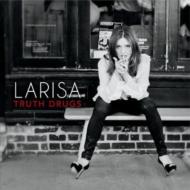
My lifelong affair with music started over two decades ago and whisked me, literally, across Russia and around the world: from Vladivostok to Siberia to the Moscow Conservatory to The Juilliard School. Nearly a decade after graduating from Juilliard, I have recorded my debut album Truth Drugs. In this album my classical music background comes through, but the songs also integrate the sound palettes that reach beyond the world of Bach and Beethoven. Some people who have heard my music draw comparisons to Tori Amos and Kate Bush; others hear Queen and Aerosmith in the harmonic progressions of Awake and 'Crying Angels'. Fans of electronic music love Tranquilizer', in which I experiment with computer-generated sounds and compound rhythm. The album reflects my artistic vision as it exists today. That is not to say it will not evolve in the next few months. I think it may already have... As background, I was born in Vladivostok, Russia to two amateur music aficionados - a guitarist-father and a singer-mother. My initiation to the violin started just a few months after my sixth birthday. A family friend, who happened to be a violin teacher, mentioned to my parents that I had perfect pitch and that she would be delighted to introduce me to the violin. My parents were very excited at the prospect of raising a violin prodigy. They bought me a violin and, soon, I was grudgingly practicing scales after school. The Soviet education system fostered competition among students to select the most talented ones for specially-designed curriculums. After winning my first competition, I was invited to study at the gifted-and-talented school in Novosibirsk, a city renowned for it's arts and culture in the heart of Siberia, whose reputation as a dreary tundra is, in fact, ill-deserved. The six years I spent there were remarkably productive artistically. I won several competitions and toured extensively, often at the expense of attending academic classes. Two years later I was on the move again, continuing westward to Moscow to study at the pre-college of the Moscow Conservatory. In Moscow I emerged as a rebellious adolescent. Having been a poster child my whole life I felt the urge to question authority over things like going to parties and having an occasional drink with friends. On the musical front I challenged my teacher's approach during lessons by juxtaposing his ideas with my own, much to his chagrin. Despite my truculence, he persistently yet subtly nourished my talent by arranging invaluable performance opportunities. I received excellent stage exposure during my time in Moscow. Things changed abruptly, however, when I was compelled to make an emergency trip to the United States. In 1993 I was diagnosed in Russia with a brain tumor and came to Portland, Oregon for treatment. Fortunately, for me, American technology and medical expertise revealed that my brain tumor was, in fact, just a case of severe sinusitis! What?! No wonder doctors in the former Soviet Union had such a bad reputation! My good fortune continued in Portland. In addition to being cancer-free, I was introduced to a woman, a patron of the Oregon Symphony, who was enthralled with my journey and organized a solo recital for her friends. One thing led to another and, the following year, I was a scholarship student at the world-renowned Aspen Music Festival under the tutelage of famed violin pedagogue Dorothy DeLay, now deceased. At the end of that summer I received an invitation to visit New York and audition for a place at The Juilliard School. An improbable series of events led to a most natural outcome - a hallowed place at the world's elite conservatory. Juilliard proved to be challenging. My lack of fluency in the English language created difficulties both in adapting to American culture and managing the academic workload. It would take me days to write papers for class and, even then, they were not particularly well written. I also struggled to find my niche artistically. A short foray into contemporary music did not strike a chord so, instead, I started listen