CD Import

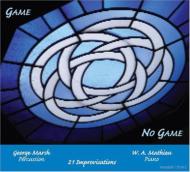
Game / No Game

George Marsh / Wa Mathieu

Item Details

Genre
:
Catalogue Number
:
MUT175182
Number of Discs
:
1
Label
:
Format
:
CD
Other
:
Import

Product Description

About Game/No Game (Liner notes by W. A. Mathieu, 2004) When George and I play together we tend to hear compositionally, that is, we try to weave coherent stories told through musical ideas. Surface texture, which is like the atmosphere of a story, does arise, of course, but strictly musical ideas drive the narrative from the inside. This means remembering (as best we can) what we've been playing. Consequently the pieces are short, typically three or four minutes. On the track list, we described the pieces but left them untitled because no matter how hard we try to find names for them, for us they remain simply pieces that sound the way they sound. Game History Viola Spolin characterized the original theater games she introduced as '...a timeless moment when all are mutually engaged in experience. You don't know what's going to happen, and that's where the joy is, the everlasting spiral.' In the 1950s, as theater games emerged in the culture, artists were learning a new definition of the present, which seemed limitless and beckoning. In 1959 I became the musical director of The Second City Theater's founding company. As part of our training program, under Viola's watchful eye, we developed theater games designed to musicalize the actors' perceptions. Mutual trust was the key. When George and I met in 1964, we began to invent musical games to guide us through the uncharted territory of free music. As we discovered our musical kinship, we found two other like-minded players (Rich Fudoli, winds, and Clyde Flowers, bass). As the Chicago Improvising Players, we developed a repertoire of games arranged in series and performed as Game Symphonies. I joined San Francisco's Committee Theater in 1967, where theater games were already a flourishing source of discipline and inspiration. The San Francisco Conservatory hired me to teach improvisation as a required course. Clyde and George moved to the Bay Area in 1968, and we three became the core trio of The Ghost Opera Company, featuring gifted students in the Conservatory and many guests from around town, including actors from The Committee. By 1970, free improvisation was in the air, and game playing was well on it's way to becoming a standard training method for both actors and musicians internationally. Meanwhile George and I have had four decades of collaboration to develop our work and trust. Game/No Game, recorded between 1999 and 2002, represents not so much the games themselves as their end result: the musical mutuality that games engender. Some Useful Games Here are a few games that have proved useful over many years: 'Sparse as Possible' asks the musicians to play as little as they possibly can and still be playing. The resulting economy thins and clarifies the texture. 'AA, BB, CC' is a memory game, useful in compositional playing. The ensemble improvises a brief phrase, then, after a pause, attempts to repeat it exactly, which is impossible, but in the attempt, one hears new details with new ears. 'One Leads' asks the other players to play only what supports the lead player. 'Who Leads' passes the leadership back and forth without visual cueing. 'Pulse' establishes a non-metered pulse-that is, any individual pulse can serve as 'one'. 'Cross-Pulse' allows several pulses to interweave and even change speed. 'East/West' spontaneously shifts the quality back and forth between receptive and expressive. 'If It Ain't Baroque' asks the players to repeat short figures until the urge to change is felt; the change must occur gradually as possible. 'Gather Ye' is a texture game where you play only what you hear the others playing. 'Syllogism' consists of three phrases, improvised collectively, called thesis, antithesis, and synthesis. ' Just Play' is the apotheosis of games, where all instructions and preconceptions fall away, and trust and pure wakefulness preside. It is the game of no game. Bios George Marsh became a professional drummer in Belleville, Illinois at the age of fifteen. His early experiences included work with Sam Andria, Jimmy Williams, and Barbara Streisand (before

Track List   

  • 01. Sometimes the Instruments Themselves Suggest Structure'
  • 02. This Is a Cross-Pulse Piece'
  • 03. Brushes Set the Mood'
  • 04. Finger-Damped Piano String Leads the Pulse'
  • 05. This Piece Seems to Pass by Like Landscape'
  • 06. Percussion Sets the Pulse, The Piano Guides the Story'
  • 07. Percussion Is All Metal; The Piano Is African-Inspired'
  • 08. Piano Leads This Motific Piece'
  • 09. Music Led Us to Its Own Mysterious Ending'
  • 10. Percussion Tells the Story in This Pulse Piece'
  • 11. Exquisitely Subtle Single Hand-Drum, With Piano Pictures'
  • 12. This Piece Reminds Me of the Gamelans of Indonesia'
  • 13. Cymbals Lead the Music in What Could Be an Act III Overture.
  • 14. Gongs and Their Strange Tunings Lead Us-Where?, The
  • 15. Percussion Leads a Cross-Pulse Piece'
  • 16. I Pay Homage to My Secret 19th Century Romantic Self'
  • 17. Scherzoid Interlude Led First by Brushes, Then Sticks., A
  • 18. This Is Like the Game Who Leads, And as Close to Jazz as We Get.
  • 19. Begins Like Gamelan Piece, But Veers Off Unexpectedly'
  • 20. This Is Another Pure Just Play Piece: No Game.
  • 21. Georgian Owl

Customer Reviews

Comprehensive Evaluation

☆
☆
☆
☆
☆

0.0

★
★
★
★
★
 
0
★
★
★
★
☆
 
0
★
★
★
☆
☆
 
0
★
★
☆
☆
☆
 
0
★
☆
☆
☆
☆
 
0

Modern Jazz Items Information

Recommend Items