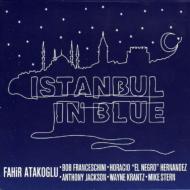
A major composer, arranger and pianist who is famous in his native Turkey and becoming increasingly well-known in the United States, Fahir Atakoglu is a true original. I'm a melody man, he says in modestly describing his music. If the melody is good, then I decide who would be best to play it and bring out it's beauty. Born in Istanbul, Atakoglu started having private lessons on piano when he was seven and began writing music in fifth grade. He studied classical music, theory and harmony while keeping his mind open to jazz and other styles. After attending college in London where he played some jobs as a musician, Atakoglu returned to Turkey in 1985, at first performing with a group of Turkish singers. The following year he began prolifically writing the music for many television commercials. In 1989 Atakoglu composed the music for a documentary about the recent history of Turkey, eventually writing for four historic documentaries. When he released the music from those soundtracks on his first album in 1994, it made him famous in Turkey. Although he relocated to the United States during 1989-90, he visits Turkey often and his national fame has grown through the years as he explores a diverse span of music. Some of his compositions have been given lyrics and have become quite popular in Turkey and Greece. In recent times, Fahir Atakoglu has recorded If (a trio set with bassist Anthony Jackson and drummer Horacio El Negro Hernandez) and the ballet East Side Story. Both of those projects are relevant in the making of Istanbul In Blue with Jackson and Hernandez joining Atakoglu in the quintet, and a few of the themes from East Side Story being utilized in the more jazz-oriented setting. Istanbul In Blue is a wide-ranging set that at first seems like jazz/rock fusion, but also includes the influences of Turkish music, some acoustic interludes, and sections that are completely unclassifiable. Atakoglu gathered together an all-star cast for the CD. In sidemen I look for musicianship, color, original styles and for whatever the musicians can bring to my melodies. I write the melody and sort of have an arrangement in mind but, when we rehearse, I listen closely to their input and how they interpret the themes. El Negro gives a new life to the odd time signatures that I use such as 7/8 and 10/8; his polyrhythms fit right in. Anthony Jackson is a genius of harmony. Both Mike Stern and Wayne Krantz are brilliant guitarists and it was a pleasure having saxophonist Bob Franceschini on the set. Much of the evolving and development that occurs within the individual pieces was created by the musicians on the spur of the moment. I leave the musicians free to interpret my music as much as possible. The program begins with Fuse On, a catchy and concise opener that is reminiscent of fusion in it's prime and does a perfect job of introducing the band. All of the musicians make strong contributions with Bob Franceschini taking a raging tenor solo that is full of fire. Sync-Op has an opening melody that hints at Turkish music, 1970s fusion and Chick Corea's Return To Forever. Atakoglu takes an impressive acoustic piano solo over the active rhythm section, Mike Stern's guitar fuses together aspects of rock and flamenco, and Franceschini's soprano solo is quite impressive. The 7/8 rhythm heard on 'Black Sea' is very common to the Black Sea region of Turkey. Turkey is very much a mix of different musical cultures from Arabs to Armenians, Greece to Egypt and Spain, with different rhythms, tempos and scales. The melody of this piece reflects the influence of that region on my music. The struttin' Aheste has a forceful theme along with fine solos from Atakoglu, Stern and Franceschini. Connection, a lyrical acoustic piece, is named after a bridge in Istanbul on which Atakoglu walked many times during this childhood. It is easy to think of this melodic and very likable number as a future jazz standard. ESS has a name that is short for East Side Story, the origin of it's melody. The piece is propelled by one of Atakoglu's best pian