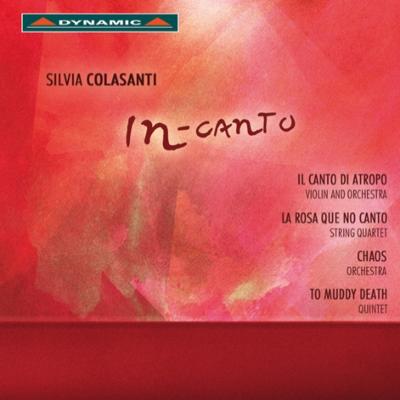
Silvia Colasanti (1975-)
Il canto di Atropo (15:01)
Orchestra Verdi
Massimo Quarta, violin / Damian Iorio, conductor
La rosa que no canto
Quartetto di Cremona
Carlo Pestelli, voce recitante
Chaos
Orchestra Haydn di Bolzano e Trento / GyOrgy GyOrgivanyi Rath, conductor
To muddy death
Algoritmo Ensemble / Marco Angius, conductor
Recorded: 2007-2010
Il canto di Atropo. Ricordo di un Maestro, written for Massimo Quarta and dedicated to the memory of Valentino Di Bella, deals with the theme of death relating to a figure of classical mythology: Atropos, one of the three Fates, who cut the thread of life at the preordained moment. Death completes the construction of our life: it recomposes the significant moments in a narrative order, making our unstable, uncertain present into a clear past. In the concert, memory of life and thoughts about death are contained one within the other, they complete one another and are reciprocally intertwined.
La rosa, a poem by Jorge Luis Borges, is the programmatic reference for the quartet La rosa que no canto. Through sound patterns that are in turn unquiet, lyrical or violent the piece runs through the various images linked to the flower: the wonder of its secret message, over which in the end a veil of regret is laid, for the ’ardent, blind’ desire that is not expressed: ’the unattainable rose’.
From the initial dismay in the birth of forms, from darkness to the bursting in of light, from a magma of sounds to the birth of melodic lines, from a very long chord of C minor suspended in the void to the explosion of the major key: thus does the mystery of the birth of the universe become a sublime vision in the Overture to Haydn’s Creation. This proffers the starting point for Chaos. Commento a Haydn, Hob. XX1:2; Ouverture; pretext for a dialogue with the past, with all the difficulties of relating to it, in continuous equilibrium between the capacity for remembering and that of forgetting.
To muddy death. Ophelia is inspired by the figure of Ophelia, the ingenuous, pure, mad girl who sings songs alluding to her betrayed love and the death of her father, and who meets her end drowning in a stream. Her death, which is not shown on stage in Shakespeare’s tragedy, is evoked in music: the initial fragment, played by the piano, develops with interruptions which are violent, jolting, shocks, screams rising to a final despairing song, accompanied only by grim bells and by the sound of a suspended cymbal immerged in water.
Silvia Colasanti (1975) is one of the leading Italian composers of her generation. Her compositions are regularly performed by major Italian and foreign music institutions, including: Theatre des Champs-Elysees (Paris), Orchestre National de Belgique (Brussels), Konzerthaus (Berlin), Biennale Musica (Venice), Kuhmon Kamarimusiikki (Kuhmo, Finland), Orchestra Nazionale Rai (Turin). The winner of several prizes (including the ”Goffredo Petrassi” prize which she received from the President of the Italian Republic), she is the artist in residence of the Civitella Ranieri Foundation in New York. Active in the field of theatre she has worked with Ferdinando Bruni, Maddalena Crippa, Francesco Frongia, Mariangela Gualtieri, Sandro Lombardi and Quirino Principe, among others.
Her works are published by Universal Publishing Ricordi.