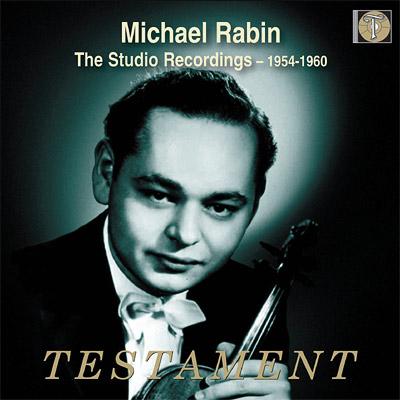
MICHAEL RABIN The Studio Recordings 1954-1960
CD1
Paganini: Violin Concerto No.1 in D, Op.6
Glazunov: Violin Concerto in A minor, Op.82
Philharmonia Orchestra / Lovro von Matacic, conductor
Saint-Saens: Havanaise, Op.83
Saint-Saens: Introduction and Rondo capriccioso, Op.28
Philharmonia Orchestra / Alceo Galliera, conductor
CD2
Tchaikovsky: Violin Concerto in D, Op.36
Philharmonia Orchestra / Alceo Galliera, conductor
Mendelssohn: Violin Concerto in E minor, Op.64
Ravel: Tzigane (Rapsodie de concert)
Philharmonia Orchestra / Sir Adrian Boult, conductor
CD3
Wieniawski: Violin Concerto No.1 in F sharp minor, Op.14
Bruch: Scottish Fantasy, Op.46
Philharmonia Orchestra / Sir Adrian Boult, conductor
Bach: Sonata No.3 in C, BWV1005
CD4
Paganini: Violin Concerto No.1 in D, Op.6
Wieniawski: Violin Concerto No.2 in D minor, Op.22
Philharmonia Orchestra / Sir Eugene Goossens, conductor
Ysaye: Sonata in C minor, Op.27 No.4
Ysaye: Sonata in D minor, Op.27 No.3
CD5
Paganini: Caprices Nos.1-24, Op.1
CD6
Mosaics
Wieniawski, arr. Kreisler: Etude-caprice, Op.18 No.4
Debussy, arr. Roques: La valse que lente (valse)
Ravel: Piece en forme d’Habanera
Chopin: Nocturne, Op.27 No.2
Mompou: Jeune filles au jardin - No.5
Scriabin: Etude in Thirds, Op.8 No.10
Sarasate: Habanera, Op.21
Elgar: La capricieuse, Op.17
Engel, arr. Zimbalist: Shell shells
Sarasate: Zapateado, Op.23
Prokofiev: Love for Three Oranges, Op.33 - March
Suk: 4 Stucke, Op.17, No.4 'Burlesca'
Leon Pommers, piano
The Magic Bow
Massenet: Thais - Meditation
Kreisler: Caprice viennois, Op.2
Dinicu, arr. Heifetz: Hora staccato
Sarasate: Zigeunerweisen, Op.20
Paganini, arr. Kreisler: Moto perpetuo, Op.11
Brand, arr. Kreisler: The Old Refrain
Rimsky-Korsakov: Tale of Tsar Saltan - Flight of the Bumble Bee
Saint-Saens: Introduction and Rondo capriccioso, Op.28
Hollywood Bowl Symphony Orchestra / Felix Slatkin, conductor
Michael Rabin, violin
For the last eleven years of his life Michael Rabin was without an active recording contract. We know from an interview that he gave six months before his accidental death that this hurt him. Rabin longed to record the Beethoven and Brahms Concertos and saw more opportunities to explore the nineteenth-century violinist-composer repertoire, but this was not to be.
Would the ending have been different had Rabin stayed with EMI as Walter Legge wanted? Did his decision to opt for Capitol over EMI, for reasons that were perhaps no more complex than wanting to travel less, hurt his long-term recording prospects by severing a direct connection with someone who had the ability to hear what hard-nosed marketing men could not? Towards the end of 1964 Rabin accepted a reduced royalty from EMI on the re-issue of his recordings, but within a few years even these meagre offerings were gone. 'All but two or three of my records have been deleted' he ruefully informed the Philadelphia Inquirer, 'I tried to get [Capitol] to re-issue them or send me the rights to them, but nothing has happened. I guess I can't blame the recording companies for not helping me. The Classical business is in trouble, I hear...' This admission of defeat was not, however, the end of attempts at resurrecting his recorded legacy. After her son's death Jeanne Rabin took up the cause, writing to EMI and Capitol and expressing a wish to reissue the recordings at her own expense. There was mention of Capitol charging her one dollar a pressing with the money generated by sales going to establish a Memorial Trust Fund in her son's name. This too never came to pass. But the truism that great art tends to outlive the artist is borne out by Rabin's posthumous fate.