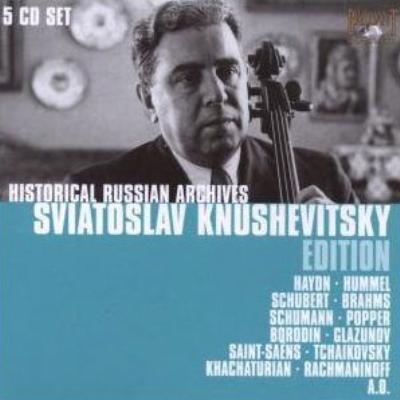
Sviatoslav Knushevitsky Edition (5CD)
Babadzhanian: Trio for violin, cello & piano in F-sharp minor
Borodin: String Sextet in D minor
Brahms: Cello Sonata No. 1 In E Minor, Op. 38 (Allegretto quasi menuetto)
Glazunov: String Quintet Op.39
Grieg: Cello Sonata in A minor, Op. 36 (Andante)
Haydn: Four London Trios
Hummel, J: Septet in D minor Op. 74
Khachaturian: Concerto for Cello & Orchestra
Miaskovsky: Cello Sonata No. 1 in D major, Op. 12
Popper: Cello Concerto in C
Rachmaninov: Cello Sonata in G minor, Op. 19
Saint-Saens: Cello Concerto No. 1 in A minor, Op. 33
Schumann: Piano Trio No. 2 in F major, Op. 80
Tchaikovsky: Variations on a Rococo Theme in A, Op. 33
Sviatoslav Knushevitsky (cello)
David Oistrakh (violin), Rudolf Barshai (viola)
Alexander Goldenweiser (piano), Arno Babadzhanian (piano) & Lev Oborin (piano)
Moscow Symphony Orchestra, Alexander Gauk, conductor
Recorded 1946-52
Born in 1908, Knushevitsky studied at the Moscow Conservatory with Semyon Kozolupov. He was senior to Rostropovitch and Shafran, and he graduated with a gold medal the same year as Emil Gilels took the pianohonours. Joining the Bolshoi Theatre orchestra in 1929, he remained their principal cello until 1943. In 1940 he co founded one of the most famous piano trios of all time with David Oistrakh and Lev Oborin.Knushevitsky’s jet-setting life style eventually (along with his alcohol dependency) to its toll, and he suffered a heart attack, which killed him, aged 55 in 1963. Gliere, Khachaturian and Miaskovsky all wroteconcertos for him, and his repertoire embraced not only the mainstream , but contemporary and rarer workssuch as the Strauss sonata and the Reger Suites, plus an extensive array of crowd pleasing encores such as Chopin’s op.25 C sharp minor etude ‘left hand’, transcribed by Glazunov. His style of playing was lyrical, and had great emotional depth. Had he not succumbed to drink he would have challenged Rostropovich as the pre-eminent Russian cellist of the 20th century. As it is his reputation is considerable, and this 5CD collection allows the listener to experience his remarkable music-making.
One of the great names of 20th century Russian musical life
Four cello concertos, sonatas, trios, and other chamber works feature in this set.
Knushevitsky is accompanied by artists such as Lev Oborin, David Oistrakh, AlexanderGoldenweiser (a pupil of Arensky and a friend of Tolstoy)
The recording of the Khachaturian concerto is that of the first performance
Extensive booklet essay by Ates Orga ( Brilliant Classics )