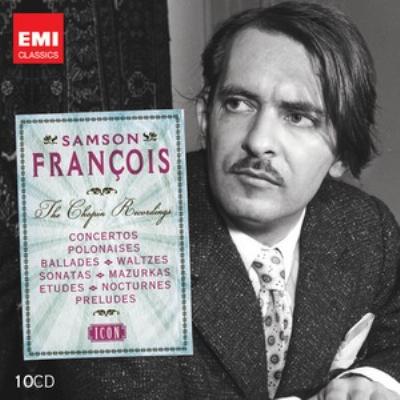
Samson Francois - The Chopin Recordings
Samson’s early recordings, dating from the end of the 1940s, were mainly devoted to Frederic Chopin, who already occupied a prominent position in his concert programmes.
The height of Samson’s art is probably to be found in the ballades (recorded between 26 and 28 October 1954, and first issued as an immensely successful 10" LP) and the dazzling interpretation of the nocturnes (recorded in May and June 1966).
In the ballades and the nocturnes Samson establishes an all-embracing colour with the aid of the loud pedal, although he modulates its power and creates a rainbow effect through the highly skilled, yet quite unpredictable use of the soft pedal. This alternation between the two pedals gives a breathless feeling to his approach. You will never find there the peaceful, semi-philosophical havens, nor the “landscaped” perspectives of neo-Classical pastoralism favoured by so many of his fellow artists, notably in the Fourth Ballade.
Samson strikes a balance between the visual and the narrative. The harmonic suspensions, which form the nub of the ballades, seem as if they are absorbed by this visionary ability, and all that preceded and all that followed could only be narration. Rarely have other pianists taken a similar view, and only Claudio Arrau - in his legendary first recording of the ballades made in 1953 - evolved within this perspective.
The nocturnes, recorded twelve years later, in 1966, possess the same burnished colour that characterises a Rembrandt background, despite the more analytical clarity cast by stereo sound. Once again it is Arrau, who, by voluntarily darkening his range of colours, seems to come nearest to this sultry vision of the nocturnes, while another leading interpreter of the cycle, the Polish pianist Stefan Askenase, was to fix his gaze obstinately in the direction of moonlight and the bel canto aesthetic.
If we are to go by the history of gramophone recording, no other pianist before him had discovered the personal, inimitable accent which Samson gives to the melodic pattern of these works, and which was not to be taken up by any other: over-intimate, perhaps, or over-rhapsodic, it is stylistically close to improvisation. If Samson still seems to be following a given declamatory scheme in the ballades, then the range of styles and expressiveness which he deploys for the abundant inventiveness of the nocturnes, has nothing to do with the innermost nature of the interpreter. For a good decade, Samson did not go back on his beliefs: he reinforced them.
Samson’s life was abruptly cut short in 1970 at a ridiculously early age - he was 46. Neither as pupil nor as teacher did he have any interest in pedagogy. Was this because he chose to keep his distance from all relationship or dependency? There is something of the stateless person in Samson’s pianistic style.
Furthermore, it seems very difficult to compare his art with that of other pianists. However, those French pianists of the new generation who have rediscovered Chopin (in large part thanks to Samson’s recordings), would seem to be in his debt. ( EMI )
Tracklist
CD 1
Piano Concerto No.1, Op.11 E minor
1 I: Allegro maestoso
2 II: Romanze: Larghetto
3 III: Rondo: Vivace
Monte Carlo National Opera Orchestra / Louis Fremaux
Piano Concerto No.2, Op.21 F minor
4 I: Maestoso
5 II: Larghetto
6 III: Allegro vivace
Monte Carlo National Opera Orchestra / Louis Fremaux
CD 2
Polonaises
1 No.1: C sharp minor, Op.26 No.1
2 No.2: E flat minor, Op.26 No.2
3 No.3: A major, Op.40 No.1
4 No.4: C minor, Op.40 No.2
5 No.5: F sharp minor, Op.44
6 No.6: A flat major, Op.53
7 No.7: A flat major (‘Polonaise brillante’), Op.61
8 Andante spianato et grande Polonaise, Op.22 E flat major
CD 3
Polonaises posthumes
1 D minor, Op.71 No.1
2 B flat major, Op.71 No.2
3 F minor, Op.71 No.3
4 Fantaisie, Op.49 F minor
5 Tarentelle, Op.43 A flat major
6 Barcarolle, Op.60 F sharp major
7 Rondo for 2 pianos, Op.73 C major
With Pierre Barbizet piano
CD 4
Ballades
1 No.1: G minor/g-moll/sol mineur, Op.23
2 No.2: F major/F-dur/fa majeur, Op.38
3 No.3: A flat major/As-dur/la bemol majeur, Op.47
4 No.4: F minor/f-moll/fa mineur, Op.52
Scherzos
5 No.1: B minor/h-moll/si mineur, Op.20
6 No.2: B flat minor/b-moll/si bemol mineur, Op.31
7 No.3: C sharp minor/cis-moll/ut diese mineur, Op.39
8 No.4: E major/E-dur/mi majeur, Op.54
CD 5
Valses
1 No.1: E flat major (‘Grande Valse brillante’), Op.18
2 No.2: A flat major (‘Valse brillante’), Op.34 No.1
3 No.3: A minor, Op.34 No.2
4 No.4: F major (‘Valse brillante’), Op.34 No.3
5 No.5: Grande Valse. A flat major, Op.42
6 No.6: D flat major, Op.64 No.1
7 No.7: C sharp minor, Op.64 No.2
8 No.8: A flat major, Op.64 No.3
9 No.9: A flat major, Op.69 No.1
10 No.10: B minor, Op.69 No.2
11 No.11: G flat major, Op.70 No.1
12 No.12: F minor, Op.70 No.2
13 No.13: D flat major, Op.70 No.3
14 No.14: E minor, Op. posth.
Impromptus
15 No.1: A flat major, Op.29
16 No.2: F sharp major, Op.36
17 No.3: G flat major, Op.51
18 No.4: C sharp minor (‘Fantaisie-Impromptu’), Op.66
CD 6
Sonata No.2, Op.35 B flat minor
1 I: Grave - Doppio movimento
2 II: Scherzo: Presto, ma non troppo - Piu lento - Tempo I
3 III: Marche funebre: Lento
4 IV: Finale: Presto
Sonata No.3, Op.58 B minor
5 I: Allegretto maestoso
6 II: Scherzo: Molto vivace
7 III: Largo
8 IV: Finale: Presto, ma non tanto
Mazurkas
9 No.1: F sharp minor, Op.6 No.1
10 No.2: C sharp minor, Op.6 No.2
11 No.3: E major, Op.6 No.3
12 No.4: E flat minor, Op.6 No.4
13 No.5: B flat major, Op.7 No.1
14 No.6: A minor, Op.7 No.2
15 No.7: F minor, Op.7 No.3
16 No.8: A flat major, Op.7 No.4
17 No.9: C major, Op.7 No.5
18 No.10: B flat major, Op.17 No.1
19 No.11: E minor, Op.17 No.2
20 No.12: A flat major, Op.17 No.3
21 No.13: A minor, Op.17 No.4
22 No.14: G minor, Op.24 No.1
23 No.15: C major, Op.24 No.2
24 No.16: A flat major, Op.24 No.3
25 No.17: B flat minor, Op.24 No.4
CD 7
Mazurkas
1 No.18: C minor, Op.30 No.1
2 No.19: B minor, Op.30 No.2
3 No.20: D flat major, Op.30 No.3
4 No.21: C sharp minor, Op.30 No.4
5 No.22: G sharp minor, Op.33 No.1
6 No.23: D major, Op.33 No.2
7 No.24: C major, Op.33 No.3
8 No.25: B major, Op.33 No.4
9 No.26: C sharp minor, Op.41 No.1
10 No.27: E minor, Op.41 No.2
11 No.28: B major, Op.41 No.3
12 No.29: A flat major, Op.41 No.4
13 No.30: G major, Op.50 No.1
14 No.31: A flat major, Op.50 No.2
15 No.32: C sharp minor, Op.50 No.3
16 No.33: B major, Op.56 No.1
17 No.34: C major, Op.56 No.2
18 No.35: C minor, Op.56 No.3
19 No.36: A minor, Op.59 No.1
20 No.37: A flat major, Op.59 No.2
21 No.38: F sharp minor, Op.59 No.3
22 No.39: B major, Op.63 No.1
23 No.40: F minor, Op.63 No.2
24 No.41: C sharp minor, Op.63 No.3
25 No.42: G major, Op.67 No.1
26 No.43: G minor, Op.67 No.2
27 No.44: C major, Op.67 No.3
28 No.45: A minor, Op.67 No.4
29 No.46: C major, Op.68 No.1
30 No.47: A minor, Op.68 No.2
31 No.48: F major, Op.68 No.3
32 No.49: F minor, Op.68 No.4
33 No.50: A minor
34 No.51: A minor
CD 8
Etudes, Op.10
1 No.1: C major
2 No.2: A minor
3 No.3: E major
4 No.4: C sharp minor
5 No.5: G flat major
6 No.6: E flat minor
7 No.7: C major
8 No.8: F major
9 No.9: F minor
10 No.10: A flat major
11 No.11: E flat major
12 No.12: C minor
Etudes, Op.25
13 No.1: A flat major
14 No.2: F minor
15 No.3: F major
16 No.4: A minor
17 No.5: E minor
18 No.6: G sharp minor
19 No.7: C sharp minor
20 No.8: D flat major
21 No.9: G flat major
22 No.10: B minor
23 No.11: A minor
24 No.12: C minor
Nouvelles Etudes, Op. posth.
(pour la ‘Methode des Methodes’ de Moscheles)
25 No.1: F minor
26 No.2: D flat major
27 No.3: A flat major
CD 9
Nocturnes
1 No.1: B flat minor, Op.9 No.1
2 No.2: E flat major, Op.9 No.2
3 No.3: B major, Op.9 No.3
4 No.4: F major, Op.15 No.1
5 No.5: F sharp major, Op.15 No.2
6 No.6: G minor, Op.15 No.3
7 No.7: C sharp minor, Op.27 No.1
8 No.8: D flat major, Op.27 No.2
9 No.9: B major, Op.32 No.1
10 No.10: A flat major, Op.32 No.2
11 No.11: G minor, Op.37 No.1
12 No.12: G minor, Op.37 No.2
13 No.13: C minor, Op.48 No.1
CD 10
Nocturnes
1 No.14: F sharp minor, Op.48 No.2
2 No.15: F minor, Op.55 No.1
3 No.16: E flat major, Op.55 No.2
4 No.17: B major,Op.62 No.1
5 No.18: E major, Op.62 No.2
6 No.19: E minor, Op.72 No.1
Preludes, Op.28
7 No.1: C major
8 No.2: A minor
9 No.3: G major
10 No.4: E minor
11 No.5: D major
12 No.6: B minor
13 No.7: A major
14 No.8: F sharp minor
15 No.9: E major
16 No.10: C sharp minor
17 No.11: B major
18 No.12: G sharp minor
19 No.13: F sharp major
20 No.14: E flat minor
21 No.15: D flat major
22 No.16: B flat minor
23 No.17: A flat major
24 No.18: F minor
25 No.19: E flat major
26 No.20: C minor
27 No.21: B flat major
28 No.22: G minor
29 No.23: F major
30 No.24: D minor