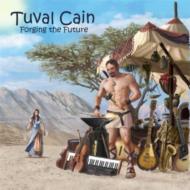
The Tuval Cain project was conceived by David Lawrence Kuhn, an American who made aliyah (immigrated) to Israel in 2002. Tuval Cain's debut album, Forging the Future, is a tour de force of neo-classic rock with a creative energy that hasn't been seen since 1970s progressive bands, without losing sight of mainstream appeal. It's range of styles include a unique type of jazz-rock fusion and features lyrics that are as powerful as the music. The project took 26 years from conception to release. The earliest song appearing on Forging the Future was written in 1987 and might never have seen the light of day had it not been for a radical change in it's author's course of life. The author describes having been to hell in his lifetime, including epression, self-destruction, rebellion, and a life of excess. This album reflects the author's personal saga, including the ongoing struggle between hedonism and self control, culminating in a refound faith. This project features some of Israel's leading musicians, including Avi Singolda on guitar, who is widely considered to be one of Israel's #1 guitarists. It also features Dor Nagar on vocals, a singer that can be counted as one of the handful of truly great rock singers; Adam Ben Ezra on bass has played with many outstanding performers and has a blossoming solo career; Ido Maimon is one of the leading and busiest drummers in Israel, and David Lawrence Kuhn on keyboards, influenced by the likes of Jon Lord, Keith Emerson, Ray Manzarek, and Dave Brubeck. The musicians on this album have played with an array of Israel's most acclaimed musicians, such as: Shlomo Artzi, Mosh ben Ari, Sarit Hadad, Idan Raichel, and Arik Einstein. (Full credits below) Produced and arranged by Noam Hartmann and Avi Chen at the Mushroom recording studio in Ramat Gan, this album has a rich tapestry of sounds, including sax, flute and violin. Influences include Deep Purple Jethro Tull, the Doors, The Beatles, Steely Dan, Queen, Kansas, Van Morrison, Paul Simon, Rainbow, ELP, Yes, Kansas, Blood Sweat and Tears, Crosby Stills and Nash, Bob Dylan, Pink Floyd, Black Sabbath, Meatloaf, Rush, Brian Setzer, Stray Cats, Andrew Lloyd Weber, Dave Brubeck, Thelonious Monk, Mozart, Mussorgsky, and Bach. The name Tuval Cain comes from the book of Genesis. He is a direct descendant of Cain, and was the originator of working with iron, bronze, and brass. As such, he is blamed by some for creating weapons for mass murderers, but he must also be credited with making tools for working the land. He was the first chemist, a master of martial arts, and known as the strongest man alive. His brother, Yuval, invented the harp and flute. Tuval Cain was tragically killed by his own father. The songwriter aims to promote more positive messages than is common in rock these days while not holding back at all from rocking out, or reducing the songs to a sanitized version. The track Nomad will be appearing in Prog Rock Magazine's Unsigned Bands competition with voting open to the general public between Sept 23rd and Oct 23rd. FULL CREDITS David Lawrence Kuhn: All music, lyrics, and keyboards Dor Nagar: Lead vocals on all songs Avi Singolda: Guitars on all Songs Ido Maimon: Drums and percussion on all songs Adam ben Ezra: Electric bass on Don't Try to Change Me, Retrobate, and Wandering I; acoustic bass on Nomad, Spiral Down, Looking Glass Love, No More Need. Noam Hartman: Bass on Power, A Distant Well, Looking Glass Love, There will be Time, Jonah, The World is My Dominion; and Shofar (Ram's horn) on Jonah. Shaul Barkan: Alto and tenor sax on Nomad, Power, and There will be Time. Guy Wittenberg: Alto sax A Distant Well, Retrobate, sax solo on Nomad and violin on Nomad. Udi Perlman: Flute on Spiral Down, No More Need, Wandering I Tal Yehoshua Karat: Vocals on There will be Time, Don't Try to Change Me Avi Chen: Additional guitar on There will be Time Produced, Arranged, Recorded and Mixed by Noam Hartmann and Avi Chen at the Mushroom Recording Studio in Ramat Gan, Israel. Mastered by Jeff Willens at Zanvil audio. Cyril van der Haegan - Co