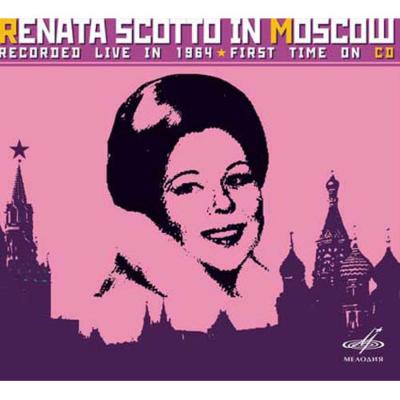
Renata Scotto in Moscow
VINCENZO BELLINI (1801-1835)
1. Juliet's Romance ("I Capuleti e i Montecchi") 8.10
2. Amina's Scene and Aria ("La Sonnambula") 13.06
GAETANO DONIZETTI (1797-1848)
3. Adina's Aria ("L'elisir d'amore", act 2) 4.08
GIUSEPPE VERDI (1813-1901)
4. Violetta's Aria ("La Traviata", act 4) 3.54
5. Gilda's Aria ("Rigoletto", act 2) 5.55
6. Violetta's Scene and Aria ("La Traviata", act 1) 7.43
GIACOMO PUCCINI (1858-1924)
7. Mimi's Arietta ("La Boheme", act 3) 3.27
8. Cio-Cio-san's Aria ("Madama Butterfly", act 2) 4.21
FRANCESCO PAOLO TOSTI (1846-1916)
9."Oh Vuchella" 3.52
GIOACHINO ANTONIO ROSSINI (1792-1868)
10. Tarantella 3.00
GIACOMO PUCCINI (1858-1924)
11. Lauretta's Arietta ("Gianni Schicchi") 2.38
Total time: 60.19
RENATA SCOTTO, soprano
ANTONIO TONINI, piano
Live recording in Bolshoi Hall of Moscow Conservatory in 1964.
Sound producer: I. Veprintsev
This is the first time when the Italian Opera House "La Scala" soloist Renata Scotto's recital is released on CD. The recital took place in autumn of 1964 in the Bolshoi Hall of Moscow Conservatory. It was organized within the framework of Moscow tour of "La Scala" after the singer had brilliantly performed in the title role in Donizetti's "Lucia di Lammermoor" on the stage of the Bolshoi Theatre.
Renata Scotto was born in Savona, Italy in 1934. According to the singer's words, she started to learn music at the age of 12 in a private school. Her technical mastery was coned under leadership of the brilliant teacher and outstanding singer Mercedes Lopart. She made her operatic debut in her home town in 1952 at the age of 18 in front of a sold-out house as Violetta in Verdi's "La Traviata". The next year she made her "official" opera debut at the Teatro Nuovo in Milan as Violetta. The singer's success was so great that for the next season she was invited to famous "La Scala", one of the leading European opera houses. In December 1953 Scotto was given the part of Walter in Catalani's opera "La Wally" with famous Italian singers Renata Tebaldi, Mario del Monaco and Gian Giacomo Gueilfi. It was her debut in "La Scala" but Renata Scotto outshone the recognized masters.
Renata Scotto's lucky chance to show her worth fell at Edinburg Festival in 1957. She replaced Maria Callas in Bellini's opera "La Sonnambula" performing the role of Amina. Winning the universal recognition of public she became a welcome guest in many European theatres and performed in Venice, London, Munich, Berlin and many other cities.
On October 13th 1965 Renata Scotto made her Metropolitan Opera debut in the leading part of Cio-Cio-san in Puccini's "Madama Butterfly". She continued to sing in this theatre up to 1987. Her repertoire that began with the lyrical parts that allowed to demonstrate the beautiful legendary Italian belcanto was expanded with the dramatic characters (in Puccini's late romantic operas as well as in the works of the Verismo composers such as U. Giordano, N. Spinelli, F. Cilea, R. Zandonai).
The 90-ies was the period of new quest that was marked by Renata Scotto's rather venturesome performances - she preformed the part of Marschallin in "Der Rosenkavalier" by R. Strauss, sang in the monoopera "Human Voice" ( "La Voix Humaine") by F. Pulenk at the Florence Musical May Festival. In 1990 three prima donnas - Ileana Cotrubas, Elena Obraztsova and Renata Scotto - joined their efforts and prepared a magnificent concert. The most difficult parts of Klytemnestra in "Elektra" by R. Wagner and Kundry in "Parsifal" by R. Strauss were performed by Renata Scotto on a level with the highest world standards.
The famous singer directed several operas - among them there are "Madama Butterfly" and "La Boheme" by Puccini , Bellini's "Il Pirata", "Norma" and "La Sonnambula", an Emmy Award-winning telecast of"La Traviata","La Wally"by A. Catalani.
When the young actress came on tour to Moscow her voice and talent were in their prime. At that time the singer's repertoire mainly consisted of the works by V. Bellini, G. Donizetti, G. Verdi and some opera parts by G. Puccini. The latter became her favourite in the following 70-ies. Now her repertoire exceeds 120 opera parts. Therefore, the best opera parts were included in the recital where she demonstrated wonderful mastery of singing notable for its steadiness in all registers, silver flying timbre. All this delights us in unsurpassed Italian belcanto. ( Melodiya )