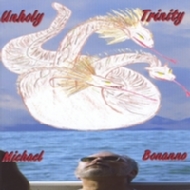
Unholy Trinity is Michael Bonanno's most personal as well as his darkest album. If you want to know more about the real unholy trinity, visit his web site, World Conditions and Action Items. Read the About page. It'll become clear. In Unholy Trinity, Michael calls three times on what he had originally written as poetry. The first poem to which he puts music is Lies, the first song on the album. The metaphors in Lies prove that Michael is familiar with the damage they can do and has seen that damage from all angles. The second poetic work is the last song on the album which is entitled Crying Heart. This, as most of the songs on Unholy Trinity, is based upon true events in Michael's life. He wrote Crying Heart hoping to stop a friend from offing himself. Michael thinks it helped, if it didn't, indeed, work. The third poem turned song is Dark Man. Dark Man is the second song on Unholy Trinity that deals with drug addiction. Drug addiction has played far too great of a role in Michael's life. As Michael says, You write what you know. Blind Pathos is a lyricist/poet with a flair for the cryptic. Monkey Chow, the second song on Unholy Trinity, isn't nearly as cryptic as it may seem at first. Listen closely. Putting music to Monkey Chow was a challenge. However, after trying to get the dark message across with dark music, Michael chooses irony with the upbeat tune. We'll be seeing more of Blind's lyrics in the future. Michael teams up again with his favorite lyricist, Jamie Redhead, on the third track. The song is called Peace. Despite appearances, Peace is a song about lost love and, yes, again, Jamie comes through with outstanding lyrics. 'Stars', The Life Song and The Power of Now might not belong on Unholy Trinity as they are anything but dark. They're full of hope. Rumor is that the album was so heavy and personally hard hitting that Michael broke it up with these three songs. When he was 49, Michael wished out loud for some benign action. It was supposed to be small talk. It was something to do with The Red Sox (Michael's originally from Connecticut). The point is that the person to whom he was speaking told him that he was 'too old to wish'. In 'Stars', Michael answers with the lines, 'No one is too old to wish/those who have never wished should try.' A positive message for such a dark album. The music of Cat Stevens is the inspiration for The Life Song. Michael maintains that Eckhart Tolle's book, THE POWER OF NOW, was the inspiration for the premise of the song with the same title. In The Power Of Now, Michael records the ending of the song in reverse. The Beatles first used this affect in their 1966 song I'm Only Sleeping. Billy Joel did it in his Nylon Curtain song Scandinavian Skies. Michael believes that John Lennon took it to the next level in his song Strawberry Fields Forever. The music, although somewhat more complex in Unholy Trinity than in previous CDs, is still the music of the Baby Boomer generation. Music has evolved since the 1960s and 70s. There may never have been a time when musical talent has been more diverse than it is today. The truth is in the pudding and some contemporary artists like Counting Crowes and The Red Hot Chili Peppers have perpetuated rock's original sound. The only difference is that Michael was there, playing and singing it in what today is known as real time. You is simply another song about lost love. It is by far the most orchestrated song on the album. Jo Ann and Ghost Writer share the same object. They may very well be the darkest songs on Unholy Trinity, although they may be a bit difficult for listeners to identify with as they are Michael's most personal of the songs. As you'll hear, Jo Ann is none too complimentary and contains what is termed explicit language. Michael says that these two songs were the most emotionally difficult songs he's ever written. You may think that you know Michael Bonanno based upon his first eight CDs. Is it possible that you can learn more about Michael by listening to the songs on Unholy Trinit