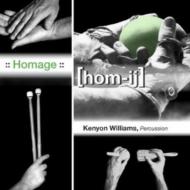
Homage [hom-ij] noun: respect or reverence paid or rendered; something done or given in acknowledgement of the worth of another. During my studies abroad, I have always been moved by how much other cultures value and respect the gift of a life-changing teacher. It is with deep gratitude that I dedicate this recording to the four men whose hands are pictured on this CD, hands that have profoundly shaped my development as a musician and as a human being. To James Campbell, Allen Teel, Benjamin Toth, and my father, Arthur Williams: thank you for everything. Kenyon Williams has worked throughout the United States as a professional performer, educator, arranger, and clinician in Western classical, non-Western folkloric, and chamber music idioms. He has performed as a guest soloist and section member for numerous orchestras throughout the country and currently serves as Principal Percussionist with the Fargo-Moorhead Symphony. As a Professor of Music at Minnesota State University Moorhead, he directs the acclaimed Fuego Tropical Percussion and World Music ensemble as well as the MSUM Percussion Ensemble. His interests have taken him abroad for extended studies in Ghana, Cuba, Brazil, Indonesia, and Trinidad. Dr. Williams is a Yamaha performing artist, currently serves as chair of the World Percussion Committee of the Percussive Arts Society, and endorses LP Instruments, Innovative mallets, and Coyle Steel Drums. 'Sedimental Structures' was originally commissioned by and composed for marimbist Robert VanSice. Written for solo four-mallet marimba, it is structured in four main sections, each of which is based on the material contained in the very first measure. The piece has an organic or earthy quality, hence the term sedimental.-Gordon Stout Percussive Arts Society Hall of Fame marimbist and composer Gordon Stout is Professor of Percussion at Ithaca College (NY). As a past composition student of Joseph Schwantner, Samuel Adler, and Warren Benson, many of his compositions are published and have become standard repertoire for marimbists world-wide. 'Duo for Tenor Steel Pan and Computer,' commissioned by Kenyon Williams from composer Cort Lippe, captures the interaction of an acoustic tenor pan as it is filtered through a computer running Max/MSP software. The computer interacts in real time with the performer-tracking pitch, timbre, volume, and rhythmic events-and responds with a variety of compositional algorithms utilizing analysis/resynthesis, spectral delay/feedback, spatialization, and more, thus allowing the performer the opportunity to actively shape the computer output. Director of the Lejaren Hiller Computer Music Studios at the University of Buffalo, American composer Cort Lippe is recognized world-wide for his expertise in composition and computer music. His compositions have received numerous prizes and he has been commissioned by internationally acclaimed soloists in virtually every medium, including strings, harp, woodwinds, brass, and percussion. His works are regularly performed at national and international festivals and are recorded on more than 30 CDs, including ADDA, CBS-Sony, Centaur, Innova, EMF, and Hungaroton Classic. Written by saxophonist and composer Russell Peterson, the 'Duo for Saxophone and Percussion' is a show-stopping work commissioned by Kenyon Williams. Marimba, vibraphone, cajon (a wooden box), doumbek (a Middle Eastern hand drum) and a small battery of percussive instruments mix and mingle with alto and soprano saxophones as the composition moves from the Funky sounds of the first movement through a hauntingly graceful Adagio before climaxing in the explosive Allegro finale. An accomplished American classical/jazz saxophonist, bassoonist and composer, Russell Peterson has soloed with orchestras and leading jazz artists in the United States as well as Europe, including receiving the top prize at the 1995 International Geneva Saxophone Concours, (Switzerland) and first place at the 1995 MTNA National Solo and Chamber Music Competition. As a composer, he has been commissioned by nume