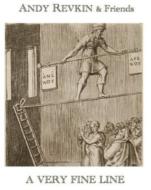
The Path to A Very Fine Line For three decades, my core occupation has been conveying stories about the environment and other subjects through journalism, books and blogging. But there are some subjects, situations and feelings that just cry out to be sung instead of typed. That fact has led me back to one of my first loves - music. A Very Fine Line, a collection of 10 of my songs, was recorded and mixed from February through September, 2013, in the Beacon, New York, studio of Joe Johnson, with contributions from a batch of brilliantly musical friends, including the songwriter Dar Williams, mandolin wizard Mike Marshall and virtuoso fiddler Bruce Molsky. You can learn about all of the contributing musicians below. My musical journey began with my parents, who both enjoyed singing informally - mainly folk songs and sea songs they learned through their shared love of sailing and my dad's time in the Merchant Marine. My father's baritone rendition of the Banana Boat Song - ...come mister tallyman, tally me bananas... - echoes in my mind as I type this. Another influence was geography. I grew up in Rhode Island, a bastion of folk music and the blues. While in high school, my brother and I began learning guitar, at first sharing my mother's nylon-stringed instrument. I instinctively (if unwisely) played the guitar upside down, creating my own chord fingerings by placing whatever fingertips felt best on the locations indicated by the black dots in a chord book. And of course there was radio. I came of age in the late 1960's and early 1970's, when you could listen to WPRO and hear, in the span of an hour, everything from Dylan and the Beatles to the Four Seasons and Herb Alpert. This album has traces of all those sounds and styles. At 17, I bought my first guitar. It was in pieces - an old acoustic that was sitting half mummified in crumbling masking tape in the corner of a music store in Halifax, Nova Scotia. (I was visiting that city as a high school junior traveling with a friend's family to a youth sailing competition.) The guitar looked like it had been through a bar fight, but I could see it was a Gibson, so I swooped. At first, the shop owner said it wasn't for sale. But then, perhaps realizing he had a lot of work ahead of him to restore it, he sold it to me for $35. When I got home, my dad, a practical and thrifty man, didn't hide his anger. How could I pay $35 for a broken guitar? If I didn't fix it by summer's end, he said, he would throw it away. I buckled down in his wood shop and fixed it, replacing a shredded side with thin mahogany plywood that I steamed into shape. I still have that beaten, bruised, but booming 1949 sunburst Southern Jumbo (yes, and a few others now). I quickly learned basic mandolin and banjo, as well. I made my first serious money as a musician (up to $100 a day!) busking in Newport during the Bicentennial celebrations of 1976 with my friend Mike Bonaiuto, who had an attention-grabbing hammered dulcimer. Then journalism took over for the most part. In the early 1990's, going through a rough patch, I began writing and performing songs - about everything from piles of bills to an epic fight with a bigmouth bass, and of course love and loss. But I never got around to recording seriously until now. I was spurred in part by a 2011 stroke - a very lucky stroke in my case - that for about a month deprived me of the use of my right hand (playing left handed, that's the one that does much of the work). As the title song of this album goes, Most of your life you spend walking a very fine line. I didn't want to waste any more time. Life is a Band I was mainly a solo performer from high school on beyond college, but shifted increasingly to playing with other musicians, particularly after moving from Brooklyn to the Hudson Highlands north of New York City in 1991. It'd be hard to live in this region and not play with others, given that the others include Pete Seeger and the galaxy of talented singers and players for whom he has been a lodestone. You can get a taste of this scene on the first Fri