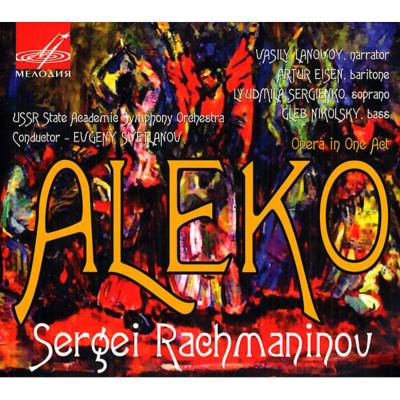
Sergei Rachmaninov: Aleko - Opera in One Act
Vasily Lanovoy, narrator
Aleko - Artur Eisen, baritone
Zemfira - Lyudmila Sergienko, soprano
Old Man, Zemfira’s father - Gleb Nikolsky, bass
Young Gypsy - Gegam Grigoryan, tenor
Old Gypsy Woman - Anna Volkova, mezzo-soprano
Gypsies - chorus
USSR Academic Grand Chorus of Radio & TV - Lyudmila Yermakova, Artistic Director
USSR State Academic Symphony Orchestra
Evgeny Svetlanov, conductor
Recorded in 1990.
In 1892 the Moscow Conservatory graduated another pleiad of young talented musicians. Among them, was a 19-year-old Sergei Rachmaninov, a future great composer, the muse and the glory of the Russian nation. His amazing gift was not left unnoticed by the professors of the composition department. The object of their amazement was Rachmaninov’s diploma work, a one-act opera Aleko that he created for 17 (!) days. Despite his first test of the pen in the genre, the piece was distinguished by a surprising integrity of the plot, vividness of the major psychological images, and freshness of intonations and melodic patterns. Rachmaninov took a fancy to Pushkin’s story about a self-willed Zemfira, her dispassionate, aggravated with life old father, and a savage stranger Aleko, who made a remarkable triangle of characters for collisions and confrontations - key principles of musical development in the composer’s creative work.
Unlike the piano and symphony genres, opera never became the leading direction in Rachmaninov’s musical legacy. A decade later he wrote two more operas - The Miserly Knight (1903) and Francesca da Rimini (1904), but neither of them proved to be as popular and cherished by the Russian heart as Aleko.
From 1893, when the opera premiered at the Bolshoi Theatre, Aleko has seen a multitude of stagings by professional and amateur companies all over Russia. An inimitable part of Aleko was played Fyodor Shalyapin, a close friend of Rachmaninov. Ivan Petrov (conducted by N. Golovanov, 1951) and Evgeny Nesterenko (conducted by D. Kitaenko, 1987) were also among the most successful performers of the part. Unfortunately, the way the opera was interpreted by Evgeny Svetlanov has not been that widely recognized despite its uniqueness. Its recording of 1990 is presented on this album. Just like Svetlanov’s symphonic renditions, his version of Aleko sounds fundamental, solid, and at somewhat slower tempos. At the same time, one can feel and extraordinary growth by the culmination finale and a most intense dramatic settlement of the conflict situation. Aleko’s part is masterfully performed by an outstanding singer Artur Eisen. The introduction of the narrator’s part was a distinctive feature of this version. The narrator recites Pushkin’s verses omitted by Rachmaninov that, as intended by the producers, help to fill in some “gaps” of the plot. The text is narrated by a brilliant Russian actor Vasily Lanovoy. ( Melodiya )