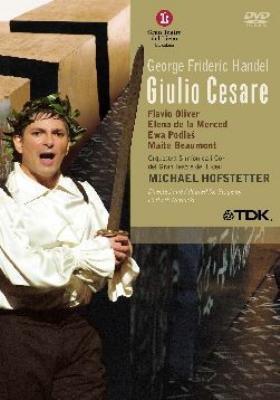
George Frideric Handel: Giulio Cesare
Gran Teatre del Liceu, Barcelona, 2004
Flavio Oliver (Giulio Cesare)
David Menendez (Curio)
Ewa Podles (Cornelia)
Maite Beaumont (Sesto)
Elena de la Merced (Cleopatra)
Jordi Domenech (Tolomeo)
Oliver Zwarg (Achilla)
Itxaro Mentxaka (Nireno)
Orquestra Simfonica i Cor del Gran Teatre del Liceu
Michael Hofstetter, conductor
Stage Director: Herbert Wernicke
NTSC
Sound Formats: PCM-STEREO, DD 5.1, DTS 5.1
Picture Format: 16:9
Subtitles: GB, D, F, I, E, Catalanisch
Region Code: 0
Running Time: 216min
TDK presents Giulio Cesare, one of Handel’s most fascinating and exquisite works on DVD. It was brought to Barcelona’s Gran Teatre del Liceu under the direction of Herbert Wernicke, who produced a new adaptation including fragments of other Handel operas such as Rinaldo, Orlando and Tolomeo. This freely-interpreted and updated version does not seek to set the opera in a contemporary context but rather to reveal hidden aspects of the work: its psychology, its history and its politics.
Originally staged in Basel, where he created a large number of productions, Wernicke’s Giulio Cesare was revived in Barcelona, in honour of this most pensive and creative of opera directors, who died in 2002. Cast with Spanish and international singers, the production once again confirmed the Teatre del Liceu as Spain’s most successful opera house.
The title role is sung by the Italian-Spanish countertenor Flavio Oliver, who is one of the foremost male sopranos in the world today. Since countertenors have come back onto the scene over the last decade, most of the high male voices are tenors with a falsetto in the alto range respectively extremely high tenors or male altos. Flavio Oliver is one of the few genuine male sopranos, singing in full voice, resorting to falsetto only in the very high range. He is also known for his excellent diction and phrasing and because he is a trained ballet dancer with a background in acting, he has an amazing physical presence on stage. Singing opposite him in the role of Cornelia, Polish Contralto Ewa Podles explores the wide range of her warm, agile voice. Soprano Elena de la Merced and mezzo-soprano Maite Beaumont complete the cast. Both are excellent Spanish singers well known on the international scene.
Wernicke, who also created the set and costumes for this production, begins his adaptation of Giulio Cesare with a crocodile strolling imperturbably across its territory. It is resentful of the sudden ? and disagreeable ? presence of outsiders. An animal with the bearing of an ancient relic, an indolent god-monster, it accepts the invasion with the contained curiosity of a thousand year old icon. The monster - the great mute protagonist of this production of Giulio Cesare - occupies the stage as a symbol of the eternal and immutable myth of Egypt. Initially the beast is the lord of its territory; by the end it has been domesticated by the invader, has forsaken its homeland and become a phenomenon of nature to be stared at by foreign eyes.
Located beneath its tail is an object crucial to the understanding of Egypt: the Rosetta stone. The plot of Giulio Cesare revolves around this key component of archaeology. Thanks to the Rosetta stone, the archaeologist Jean Francois Champollion (1790-1832) deciphered Egyptian hieroglyphs and penetrated the mythical nebula of the culture of the Pharaohs. Champollion’s work is a landmark in European Egyptology, but also marks the definitive conquest and final spoliation of a culture. Wernicke roots the action of Giulio Cesare in this historic final act of surrender.
Even in Handel’s times, the plot, costumes and context were a mere speculation and probably mostly in the fashionable “Egyptian-style”. This frees the production from the need for historical accuracy because it was already a recurrent fantasy, a myth in 1724.
Wernicke uses this concept to create a transverse encounter between different historical and artistic elements. His production merely transfers to the stage an idea, which Handel himself had sown in Giulio Cesare: disorder as a factor of emotional and cultural wealth. According to Xavier Zuber, the dramatic advisor, the second act is a reflection on the way in which Rome lost control and security when faced with another culture, which was weak in terms of its military response and political organization, but firmly anchored in a heritage dating back millennia.
Cultural wealth arising from an encounter between different worlds: this same idea is evoked by Wernicke’s mise-en-scene, which deviates from the canon of opera seria and converts Giulio Cesare into an accumulation of theatrical genres until the entire spectrum of humanity is assembled in the opera. The montage is more an idea than an action, just as Handel’s score deviates from chronological order to construct a framework in which emotions and feelings take priority over action and movement.
( TDK )