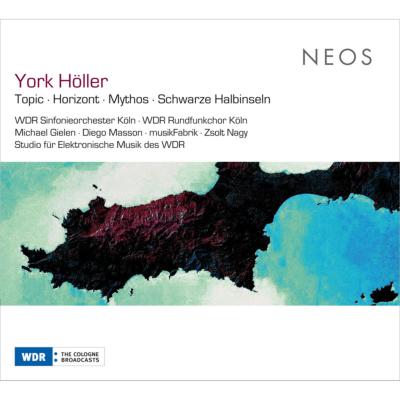
York Holler:
Topic (1967) for large orchestra - Dedicated to Bernd Alois Zimmermann
WDR Sinfonieorchester Koln / Michael Gielen, conductor
Horizont (1971/1972) quadrophonic electronic music - Dedicated to Ursula und Cuno Theobald
Studio fur Elektronische Musik des WDR
Peter Eotvos and Volker Muller, realization
Mythos (1979/1980, rev. 1995) for 13 instruments, percussion and 4-channel tape - Dedicated to Hans Zender
musikFabrik / Zsolt Nagy, conductor
Studio fur Elektronische Musik des WDR - Volker Muller, sound direction
Schwarze Halbinseln (1982) for large orchestra, vocal and electronic sounds on 4-channel tape - Dedicated to Karlheinz Stockhausen
Text by Georg Heym
WDR Sinfonieorchester Koln, WDR Rundfunkchor Koln / Diego Masson, conductor
Studio fur Elektronische Musik des WDR - Volker Muller, sound direction
Marie-Louise Gilles, speaker (tape)
Music as Speech in Sound
A Portrait of the Poet in Sounds: York Holler
York Holler achieved his breakthrough in 1967 with the premiere of Topic by the Orchestra of the Cologne Conservatory in the large broadcasting studio of the West German Radio (WDR) Cologne. As a result, a representative of the Schott publishing house offered the young composer a contract and, at the instigation of music programmer Otto Tomek, the WDR Symphony Orchestra under the direction of Michael Gielen played the revised version of the piece in 1970 at the Warsaw Autumn Festival, the Darmstadt Summer Courses, and again in Cologne. As a consequence of these repeat performances, Holler found important interpreters in Pierre Boulez, Daniel Barenboim, and Hans Zender. Moreover, he was invited by the director of the WDR Studio for Electronic Music, Karlheinz Stockhausen, to realize there his first and only purely tape recorder composition, Horizont.
Topic (1967) was Holler’s first of many orchestral works and still stood under the influence of his studies with Bernd Alois Zimmermann and the impressive premiere of Zimmermann’s major work Die Soldaten (The Soldiers) at the Cologne Opera in 1965. At times, the nine sections are extremely different in terms of character, dynamics, tempo, and instrumentation, and form a superordinate entity precisely because of their contrasts. Unmistakable is the sovereign talent of the then twenty-one-year-old composer in his handling of the large symphonic apparatus, and in the fashioning of dramatic arcs of tension. The trumpets’ fanfare attacks as well as a certain stylistic openness with occasional echoes of Baroque music and jazz are reminiscent of Zimmermann. At the same time, in spite of all unruly wildness, sometimes escalating to the cataclysmic, it is a very methodical music. The English title of the work means “theme” or “subject matter” of a discussion, and emphasizes central themes that set the tone of Holler’s entire creative work: clear construction, expressive articulation, poetic content, and the idea of music as speech in sound. Instead of rejecting the postwar serial avant-garde like other composers of his generation, Holler found his way, while taking into account perception-psychological insights, to an individual combination of structural thinking with spontaneous invention and “effective listening impression.” In doing so, he let himself be inspired time and again by extra-musical impressions, by spatial, visual, literary, philosophical, or natural-scientific concepts that open broad spaces of association and experience to the listener.
At an early stage, Holler oriented himself on the ideal of music as a living organism, all of whose component parts are contained, like in a genetic code, in every cell as well as in the structure of the whole. Analogous to this, in his 4-channel tape recorder composition Horizont (Horizon, 1971/72), he wanted to create, without a prefabricated formal plan, with relatively limited, purely electronically generated and transformed material, a stylistically uniform and, above all, “very personal world of sound” that evolves process-like. With the intersection line of the finite and infinite, the work’s title describes the intended combination of mathematical construction with musical expression or, more specifically, the formal course of the piece as an “imaginary circle that simultaneously represents closeness and openness.” The subtitle “Electronic music in the form of an essay on logarithmic feelings,” on the other hand, alludes to the “Essay on feelings” that the main character, Ulrich, of Robert Musil’s novel The Man Without Qualities intends to write. Additionally, he calls attention to the psychological circumstance that the human sensory organs’ ability to discriminate functions according to logarithmic gradations, which also determines the temporal shape of the piece.
At the end of the 1970s, Holler occupied himself with Wagner’s musical dramas as well as with Carl Gustav Jung’s psychoanalytical writings and with the Dialectic of Enlightenment jointly authored by Max Horkheimer and Theodor W. Adorno. These studies provided him with the insight that music has mimetic powers at its disposal and can help express the nature of the subject. Consequently, in the ensemble work Mythos (Myth, 1979/80, rev. 1995) he did not zero in on a specific mythological tradition, but rather on the original meaning of the term in general, as speech or narrative. Indeed, Holler calls his piece a “sound poem,” which is a good description of the double character of the music: on the one hand, it is a rationally constructed entity of great tonal wealth and direct, spontaneous-impulsive expression; on the other hand, it is music that is linguistically fashioned, as it were, in micro and macro forms, metrics, verses, and strophes. Mythos was seminal for Holler in as much as he fashioned “archetypical experiences” and “primal experiences” here for the first time on the basis of distinctive music-linguistic gestures, symphonic shape characters, and instrumentational topoi, which are however encountered here only in very stylized form: “The work is partly based on familiar poetic images and expressive characters, for example, wind, water, and the nymph Syrinx, horn call and echo, threatening gestures, a silver-colored nocturne leading into a kind of Marche funebre, Dionysian round dance, night-black hymn, etc.” Holler made use thereby of a continuum between instrumental and electronic sounds, the latter played from audio tape, which partly contrast, partly fuse seamlessly or imperceptibly blend into one another. Serving as the constructive germ cell for the harmonic, rhythmic, and formally large structures is a sound shape of the kind upon which Holler has based almost all of his compositions since his string quartet Antiphon (1976). In this case, it is a thirty-four-tone melody that begins and ends with the same tone, e-flat, and passes through all twelve chromatic tones in two differently phrased seventeen-tone halves. The result is dense, chromatically colored chord complexes beyond tonal shapes or clusters.
In Schwarze Halbinseln (Black Peninsulas, 1982), Holler sketched in dark hues a large tableau of oceanic-atmospheric sound landscapes. He oriented himself here on structures of speech rhythm, expressive gestures, and poetic images from the poem Die Nacht (The Night) by the impressionistic lyricist Georg Heym. At the beginning, above a cluster-like pedal point of electronics and low strings, lies the poem, whispered and modified to the point of unintelligibility by a woman’s voice, along with eerie women’s choruses and irreal bell sounds seemingly from distant islands. The linguistic material of the text is consistently musically transformed into a “sound poem,” and becomes intelligible only toward the end. In a letter to Holler, Karlheinz Stockhausen, the work’s dedicatee, showed himself impressed by the “rich coloring” and “broad temporal shaping.”
Rainer Nonnenmann - Translation: Howard Weiner ( NEOS )