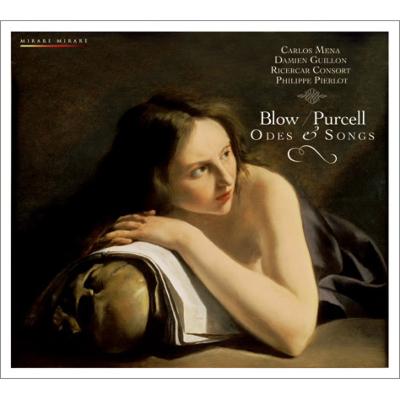
Purcell & Blow: Odes & Songs
Blow:
Ode on the Death of Mr Henry Purcell
Purcell:
Here let my life
But ah, I see Eusebia drown’d in tears
Symphony for the Flutes
Strike The Viol (Ode Come Ye Sons Of Art Away)
Her charming strains
Chaconne
A Song in the Prophetess
No, resistance is but vain
Sweetness of nature
I loved fair Celia Z381
Carlos Mena & Damien Guillon, countertenors
Ricercar Consort
Philippe Pierlot, bass viol and direction
Recorded: 10/2009
There is no record of how Purcell's unprecedented youthful genius was received by his contemporaries, though it seems logical that it must have caused considerable wonder in the musical world centred around Westminster. The reality of London musical life was in fact difficult, frenetic, and grossly underfunded, and, along with the whole city, was thrown into confusion with the outbreak of the plague, the war with the Dutch and the catastrophic fire of London. Suffice it to say that a lifelong friendship developed with John Blow, who relinquished his post as organist at Westminster Abbey to the 20-year old Purcell in 1679.
Blow's music in the Ode on Purcell's death is probably the most coherent melodious and inventive, outside his beloved Church music. It is also his most Purcellian. The choice of two countertenor voices was fundamental in this respect, and this conscious evocation of the Purcellian sound world is extended in the use of the two recorders, stressing both the funerary and other-worldly associations of the instrument. With this collaboration in memory of Purcell however, he achieves the highest level of expression. Early death, in his time was an unremarkable commonplace, and Dryden and Blow are deploring something rather different, the catastrophe of losing a friend who represented both their own hopes, and the energy and potential of English music in full flood.
Carlos Mena trained at the Schola Cantorum Basiliensis in Basel, where his teachers were Richard Levitt and Rene Jacobs. His operatic performances have included Radamisto, L’Orfeo (Speranza), Il Trionfo del Tempo e del Disinganno , Oberon in Britten’s Midsummer Night’s Dream and Death in Venice from Salzburg to Barcelona.
His recital De Aeternitate (Mirare) won a Diapason d’Or of the Year in 2002; Et Jesum (hm) was awarded the CD Compact Prize for the year 2004; his recording of Vivaldi’s and Pergolesi’s Stabat Mater (Mirare, again with the Ricercar Consort), La Cantada espanola en America (hm), Paisajes del Recuerdo (HM) and Sances’ Stabat Mater (Mirare) received awards such as Internet Classical Award, 10 Repertoire, Choc du Monde la Musique, Scherzo…
Damien Guillon studied with Andreas Scholl at the Schola Cantorum in Basel. His vocal and musical qualities have led to regular invitations to appear with such well known conductors as Herve Niquet, Jerome Correas, Philippe Pierlot, Jean-Claude Malgoire, Christophe Rousset, William Christie, Masaaki Suzuki and Philippe Herreweghe.